Mark Urban has crunched the numbers and the results are clear. For every degree that global temperatures rise, more species will become extinct.
And the risk of species loss is most acute for those continents that have unique climate ranges, with native species that can survive only in a limited range. Yet those regions are the least studied.
In a meta-analysis based on data from previously published studies, Urban, a UConn professor of ecology and evolutionary biology, reports that rises in future global temperatures will threaten up to one in six species if current climate policies are not modified.
His study, titled “Accelerating Extinction Risk from Climate Change,” appears in the
May 1 issue ofScience.

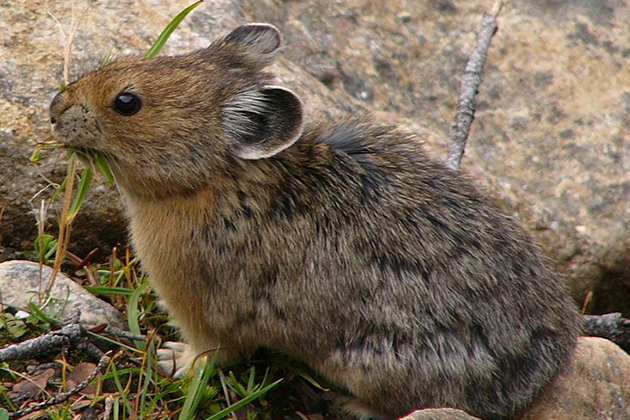
An American pika in the Canadian Rocky Mountains. Pikas live in high mountain ecosystems that are cool and moist, and can overheat in higher temperatures. Unlike other mountain species that can move to higher altitudes in warming climates, pikas live so high there is no where for them to go. (Wikimedia Commons Photo)
While there have been numerous studies on how individual species may be affected by climate change, Urban’s research is the first to take a holistic approach.
“We can look across all the studies and use the wisdom of many scientists,” Urban says. “When we put it all together we can account for the uncertainty in each approach, and look for common patterns and understand how the moderators in each type of study affect outcomes.”
Overall, the study predicts a nearly 3 percent species extinction rate based on current conditions. If the earth warms another 3°C, the extinction risk rises to 8.5 percent. And if climate change continues on that trajectory, the world would experience a 4.3°C rise in temperature by the year 2100 – meaning a 16 percent extinction rate.
Urban took a global approach with his analysis because there are inherent difficulties in comparing previous studies by various authors. Studies differed in significant ways, including assumptions, methods, species examined, and geographic regions. Findings were inconsistent and difficult to compare across species.

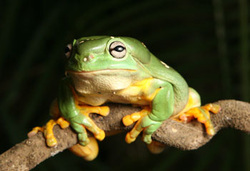
A Nursery Frog in Queensland, Australia. Found only in the Wet Tropics region, it will be unable to colonize any other area if its habitat shrinks from global warming and reduced rainfall. (Jean-Marc Hero, via Wikimedia Commons)
Further, about 60 percent of studies about the effects of climate change have centered on North America and Europe. Yet South America, Australia, and New Zealand are at greatest risk for species loss, says Urban.
The risk in South America, Australia and New Zealand is particularly troublesome because those continents have unique climate ranges and many of their native species have a limited range in which they can survive. Some of the native species with smaller ranges, such as amphibians and reptiles, face a 6 percent greater risk of extinction than do non-native species currently sharing their space.
“With Australia and New Zealand, we’re also looking at land masses that are relatively small and isolated, so that the possibility of a species shifting to a new habitat simply doesn’t exist,” he adds.
Among the discoveries he made is that extinction risks did not vary significantly by taxonomic group, a finding he describes as unexpected.

Emperor penguins, a species native to Anarctica, are being increasingly affected by habitat loss. Global warming not only reduces the amount of pack ice surrounding the continent but also causes it to melt earlier in the year. (Photo courtesy of Giuseppe Zibordi/Michael van Woert/NOAA NESDI, ORA)
“We have generally thought that certain groups were more at risk than others, but our results show that all taxonomic groups will be affected as the climate changes.
While all species affected by climate change will not become extinct, there will undoubtedly be unwanted changes to contend with.
Even species not threatened directly by extinction could experience substantial changes in abundance, distribution, and in their interactions with other species. In turn, this may affect ecosystems, crop growth, and the spread of disease, and have other unanticipated consequences.
“It’s hard enough to predict change, but in the end, we have one climate to contend with,” says Urban. “With living things, we are dealing with millions of species, none of which act precisely the same. In fact, we may be surprised, as indirect biologic risks that are not even recognized at present may turn out to have a greater impact than we’ve ever anticipated.”



No comments:
Post a Comment