A 'bungee cord' nerve found in the mouth and tongue of some whales can nearly double in length, allowing them to take swallows of food and water larger than their body.
This according to researchers from The University of British Columbia, who authored a new study in Current Biology detailing their findings.
The newfound nerve is unique to rorqual whales, the largest group of baleen whales. The whales' long nerves are packaged in such a way that they unfold completely during the swallowing process and then quickly re-packed afterward (no actual stretching, which would damage the nerve, occurs).
Researchers speculate that similar structures could be found in other animals whose body parts expand rapidly, such as frogs whose throats balloon.
"This discovery underscores how little we know about even the basic anatomy of the largest animals alive in the oceans today," says UBC postdoctoral fellow Nick Pyenson. "Our findings add to the growing list of evolutionary solutions that whales evolved in response to new challenges faced in marine environments over millions of years."
University of British Columbia (UBC) researchers have discovered a unique nerve structure in the mouth and tongue of rorqual whales that can double in length and then recoil like a bungee cord.
The stretchy nerves explain how the massive whales are able to balloon an immense pocket between their body wall and overlying blubber to capture prey during feeding dives.
“This discovery was totally unexpected and unlike other nerve structures we’ve seen in vertebrates, which are of a more fixed length,” says Wayne Vogl of UBC’s Cellular and Physiological Sciences department.
“The rorquals’ bulk feeding mechanism required major changes in anatomy of the tongue and mouth blubber to allow large deformation, and now we recognize that it also required major modifications in the nerves in these tissues so they could also withstand the deformation.”
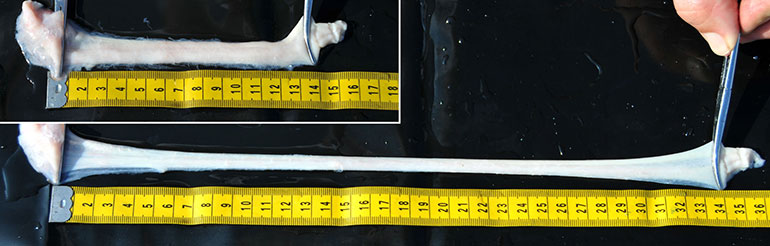
Segment of a tongue nerve at its initial length prior to being stretched. The nerve has been manually stretched to more than twice its initial length until it abruptly resists further extension.
In humans, stretching nerves usually damages them. In these whales, the nerve cells are packaged inside a central core in such a way that the individual nerve fibers are never really stretched, they simply unfold.
“Our next step is to get a better understanding of how the nerve core is folded to allow its rapid unpacking and re-packing during the feeding process,” says UBC zoologist Robert Shadwick.
The researchers don’t know yet whether anything similar will turn up in other animals — the ballooning throats of frogs, for example, or the long and fast tongues of chameleons.
“This discovery underscores how little we know about even the basic anatomy of the largest animals alive in the oceans today,” says Nick Pyenson, a UBC postdoctoral fellow currently curator of fossil marine mammals at the Smithsonian’s National Museum of Natural History. “Our findings add to the growing list of evolutionary solutions that whales evolved in response to new challenges faced in marine environments over millions of years.”
The findings are reported in Current Biology. Rorquals are the largest group among baleen whales, and include blue whales and fin whales. Specimens the researchers studied were obtained at a commercial whaling station in Iceland.


No comments:
Post a Comment