It can be difficult to get basic measurement information from the whale shark, the world's largest known fish - you can't exactly swim up to it with a measuring tape.
Researchers from Australia's Marine Megafauna Foundation are using a new measuring technique called "laser photogrammetry" that's giving them more accurate data than ever before.
According to lead researcher Chris A. Rohner, laser photogrammetry involves "projecting laser pointers onto the flank of the shark while taking a photo to provide a scale bar". His team deployed the method on live, free-swimming sharks in Mozambique as part of anew study recently published in PeerJ.
The new method could prove integral in helping conservationists protect the threatened whale shark. Rohner notes that the majority of the whale sharks observed by his team are juvenile males; there have been few sightings of newborns, mature sharks and females. Laser photogrammetry could significantly improve the scientific community's understanding of whale shark demographics and contribute to conservation efforts.
We recently published “Laser photogrammetry improves size and demographic estimates for whale sharks”. In this study, authorChristoph A. Rohner and his colleagues examine the results of a study on Whale Sharks. Christoph comments on his research and experience publishing with us.
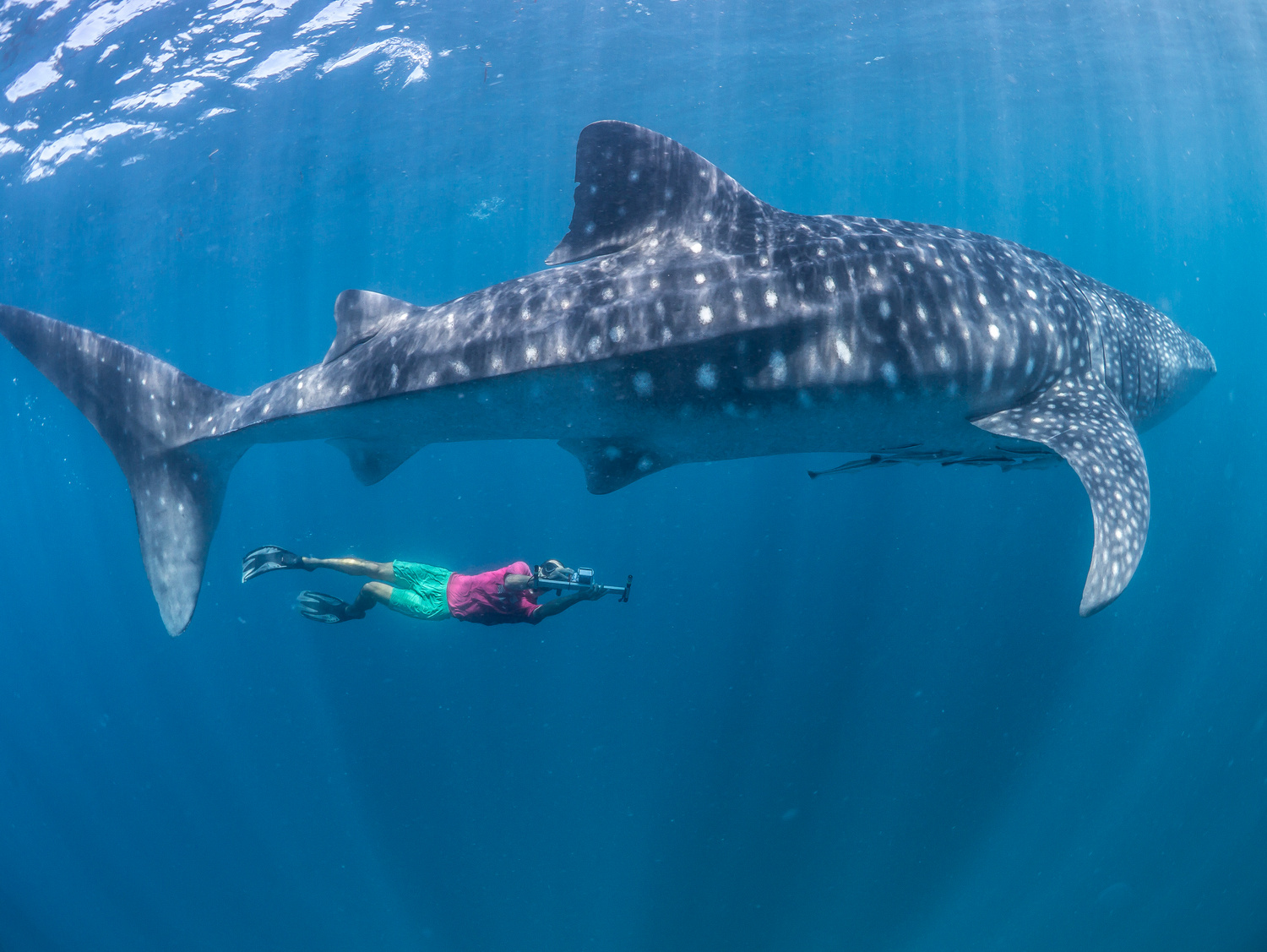
Christoph Roher taking a laser photogrammetry photo of a male whale shark’s claspers, to determine size at maturity. Credit: Simon Pierce
PJ: Can you tell us a bit about your team?
CR: We’re quite international! Simon Pierce, Clare Prebble, Andrea Marshall and myself work with the Marine Megafauna Foundation, and were based in Mozambique during the majority of data collection for this study. Simon, Clare and I did the bulk of the fieldwork together in Mozambique and Tanzania. Anthony Richardson, Mike Bennett and Scarla Weeks are from the University of Queensland in Australia, and together with Simon they formed my PhD supervisory team. Geremy Cliff and Sabine Wintner from the KwaZulu-Natal Sharks Board provided additional data from stranded whale sharks along the South African coast.
PJ: Can you briefly explain the research you published in PeerJ?
CR: We measured live, free-swimming whale sharks with laser photogrammetry – basically projecting laser pointers onto the flank of the shark while taking a photo to provide a scale bar. This technique provides more accurate size estimates than visual estimates. We found that male whale sharks reach maturity at over 9 m in length, around 2 m longer than those found in the Atlantic, suggesting biological differences among these populations. We also found that grow rates over a 1–3 year time-scale could not be measured with the technique. We likely need an improved technique of measuring whale sharks, or a longer time interval between re-measurements, to accurately determine the presumably slow growth rate of the species.
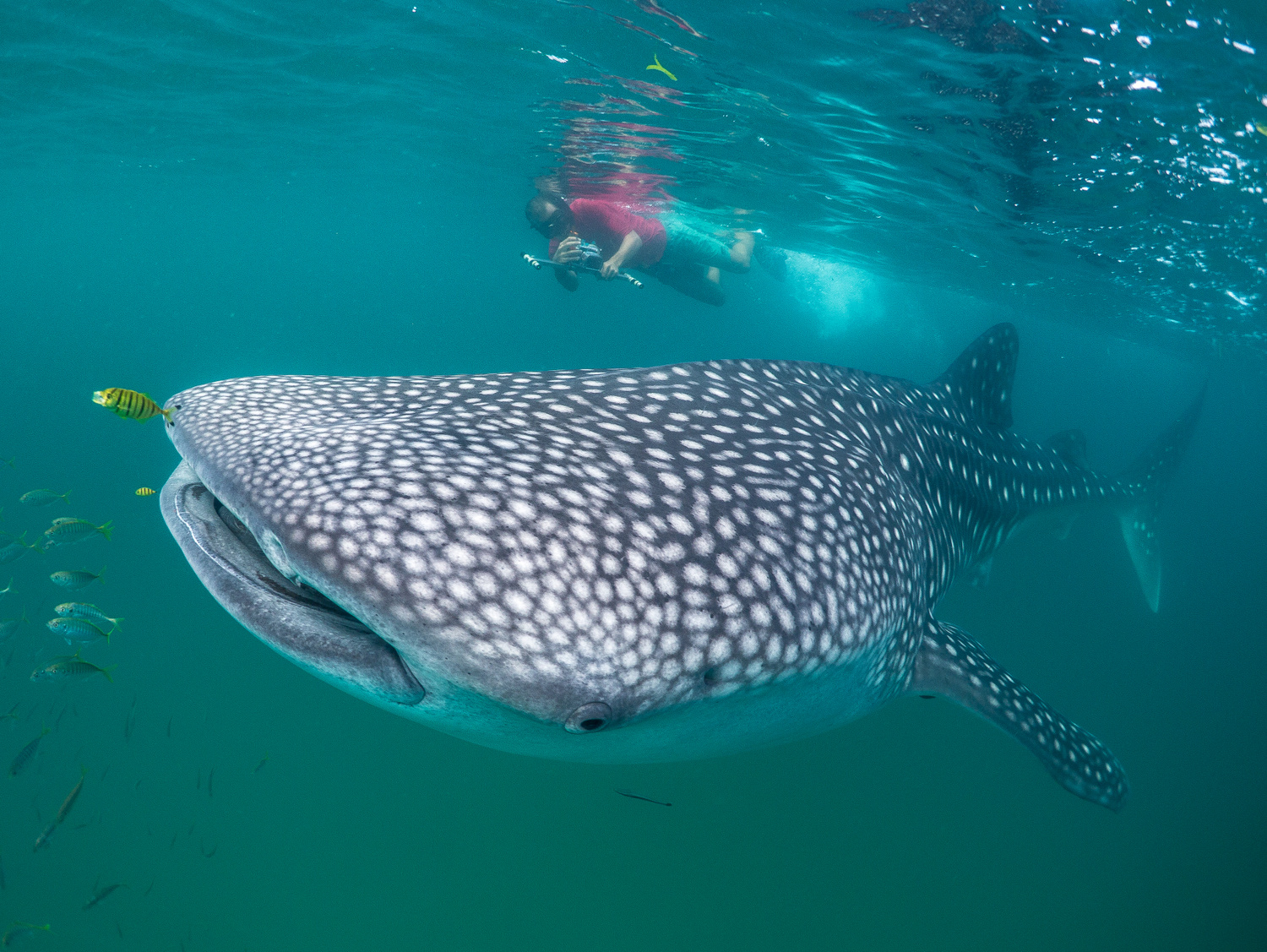
Chrisoph Rohner measuring a whale shark in Tanzania with laser photogrammetry. Credit: Simon Pierce
PJ: Do you have any anecdotes about this research?
CR: The three sharks that stranded on a beach in southern Mozambique were actually my very first whale shark encounters. I had just arrived in Mozambique ready for my (in-water) fieldwork, when we heard about the stranding. We drove by 4WD over bumpy, sandy tracks to get the remote beach and made on-site dissections continuing late into the night to beat the approaching high tide. It was an interesting start to this study, and thankfully I got the chance to swim with many live whale sharks since then.
PJ: What kinds of lessons do you hope the public takes away from the research?
CR: The whale shark is the largest fish in the ocean and, compared to many other sharks, it is relatively well studied. That being said, we still have some big gaps in our knowledge of their biology. The infographic below nicely illustrates that almost all of the sharks seen in their known feeding areas are juveniles, with a strong male bias. Where are the newborn whale sharks? Where are the females? Where are the large, mature adults? It is an exciting time to be a whale shark researcher, as we are getting closer to answering some of these big questions.

Demographic infographic on whale sharks
PJ: Can you briefly explain the demographic infographic on whale sharks?
CR: The main point of the infographic is to compare the size and sex structure of whale sharks at their aggregations around the world. The big question mark at the higher end of the size spectrum is to point out that we don’t see many big, mature sharks at these aggregations. There is also empty space at the lower end of the spectrum – whale sharks are born at ~50–60 cm in length, yet we only see them when they are >200 cm long.
PJ: How did you first hear about PeerJ, and what persuaded you to submit to us?
CR: Some of our colleagues published with PeerJ and recommended the journal due to the quick turn around and open access policy, so we gave it a go.
PJ: How would you describe your experience of our submission/review process?
CR: The publication process we had with PeerJ was smooth and fast. Our initial Editor went to Antarctica, but PeerJ quickly found a replacement to keep the process going in his absence.

Whale Shark. Credit: Simon Pierce
PJ: Would you submit again, and would you recommend that your colleagues submit?
CR: Yes to both questions. Having an Open Access option is one of the major considerations for us when selecting and outlet for our work, as we want to quickly share our findings with colleagues and managers. Working for a small non-profit organisation means we have to be cautious with our finances, and PeerJ combines these two considerations nicely.


No comments:
Post a Comment